History
Welcome to the story of St. Luke’s Church. For more than two centuries, this parish has been a place of faith, gathering, and quiet perseverance, shaped by the lives of those who came before us. Rooted in the land and sustained by generations of parishioners, the history of St. Luke’s is not only about buildings and dates, but about a community that has worshipped, served, and grown together over time.

Serving the faithful since the early 1800s
In 1825, as part of the Peter Robinson Emigration, 142 Irish families were settled in the northern part of Emily Township, from Concession 7 through Concession 23. Approximately twenty of these families were not of the Roman Catholic faith and were given land in East Emily. The remaining families formed the Catholic community that would become the parish of St. Luke the Evangelist
Emigration To Canada


The Pioneer Cemetery
One of the first needs of the early settlers was a place of burial. Land was set aside on the southwest corner of Lot 5, Concession 10, about half a mile west of Downie’s Cross, the original name of the hamlet now known as Downeyville. Death was common among the early settlers. Records from the Peter Robinson papers note that thirty one Irish settlers died in 1826, and it is believed that the Pioneer Cemetery came into use at that time.
The first recorded burial was that of William Flynn in October 1826. Although the cemetery was in use for many years, the land itself was not officially purchased by the Diocese of Kingston until 1856. In 1840, Father Hugh Fitzpatrick, pastor of St. Mary’s Church in Lindsay, led the construction of a mission log church within the cemetery. Dedicated to St. Luke, this church served the faithful for sixteen years.
1826-1907


Formation of the Parish
In 1851, St. Luke’s separated from St. Mary’s and became a parish in its own right, with Ennismore as its mission. Father John Bourke was appointed as the first pastor. For his first two years, he lived in a local hotel until a rectory could be built.
The Diocese purchased five acres of land from William Lehane on the north half of Lot 9, Concession 9, and a frame house was erected the following year. This building served as the parish rectory for twenty seven years.
By 1856, the hamlet of Downeyville had developed around a general store, a hotel, a school, and the nearby log church and cemetery. When Father Bourke proposed building a new and larger church east of the hamlet on the rectory site, he encountered strong opposition. Many parishioners believed the church should remain in the centre of the village.
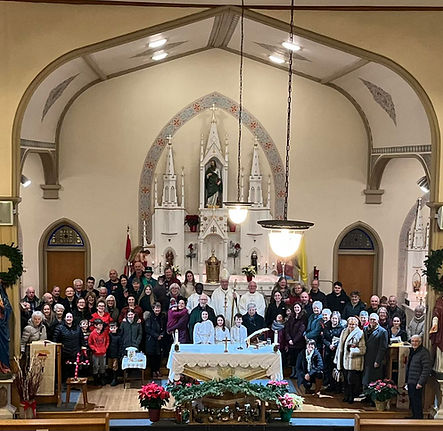
After much discussion, the Diocese purchased the present site from Bartholomew Downey. A frame church with lap board siding was constructed between 1857 and 1858. Father Bourke died during the construction and was buried beneath the church. Father Bernard Coyle succeeded him as pastor, and the church was blessed and opened in 1858.
In 1886, the chancel, vestry, and bell tower were added, completing the cruciform design of the church as it stands today. At that time, the exterior was also covered with white brick.
Building the Church


The Rectory and Parish Life
The current rectory was built in 1880, immediately south of the church. The original parish house was abandoned, and the land was sold back to William Lehane. Since its construction, the rectory has been home to nineteen resident priests, including the current pastor, Fr. Israel Orebi, MSP.
There is an unconfirmed story that the rectory was designed to accommodate a group of nuns travelling from Ireland who were to serve the parish, possibly as teachers or nurses. Tragically, their ship is said to have sunk during the crossing, and no other nuns were sent to replace them.
An original school, built in 1844 on the site of the current church parking lot, served the community until 1963, when a new school was constructed across the road. The Pioneer Cemetery was closed in 1907, and the present St. Luke’s Cemetery, located east of the village, was opened that same year.
The Parish Hall was built in 1919 to provide a space for social gatherings and both private and public meetings. For many years, it also served as a place of instruction for students in grades seven through ten.
A Living Legacy of Faith
As we look back on the generations who built, prayed, and gathered here before us, we are reminded that the story of St. Luke’s is still being written. The same faith that sustained the early settlers continues to live in the parish community today, carried forward in worship, service, and fellowship. What was begun with hope and perseverance nearly two centuries ago remains a living presence, linking past and present, and calling each new generation to be part of this shared and enduring journey of faith.